Isole e Olena’s vineyards, like those of Giovanni Manetti at Fontodi, are superbly tended. More than anything, this yields wines of the quality that have kept both these Chianti wineries ahead of the chasing pack for the past three decades.
The name ‘Isole e Olena’ came about in the 1950s when two adjoining estates, ‘Isole’ and ‘Olena’, were purchased by the De Marchi family and combined to form one. The history of both dates back hundreds of years, with the earliest documentation of the village of Olena in the 12th century. In 2022 Isole e Olena was purchased by Christopher Descours, the owner of Charles Heidsieck, Piper-Heidsieck, Rare Champagne, Château la Verrerie and Biondi-Santi. Christopher and the new estate director Emanuele Reolon have a clear vision to build on Paolo De Marchi’s exceptional results, with a restless quest for quality and excellence.
Isole e Olena is in the western part of Chianti Classico, just north of the village of Castellina. Its 45 hectares of vineyard are planted between 350 – 450 metres above sea level, primarily on galestro soil (a kind of rocky, schistous clay). Because the western flank of Chianti is open to breezes from the sea, this is a much cooler part of the zone, resulting in lighter but more scented and elegant wines than many others.
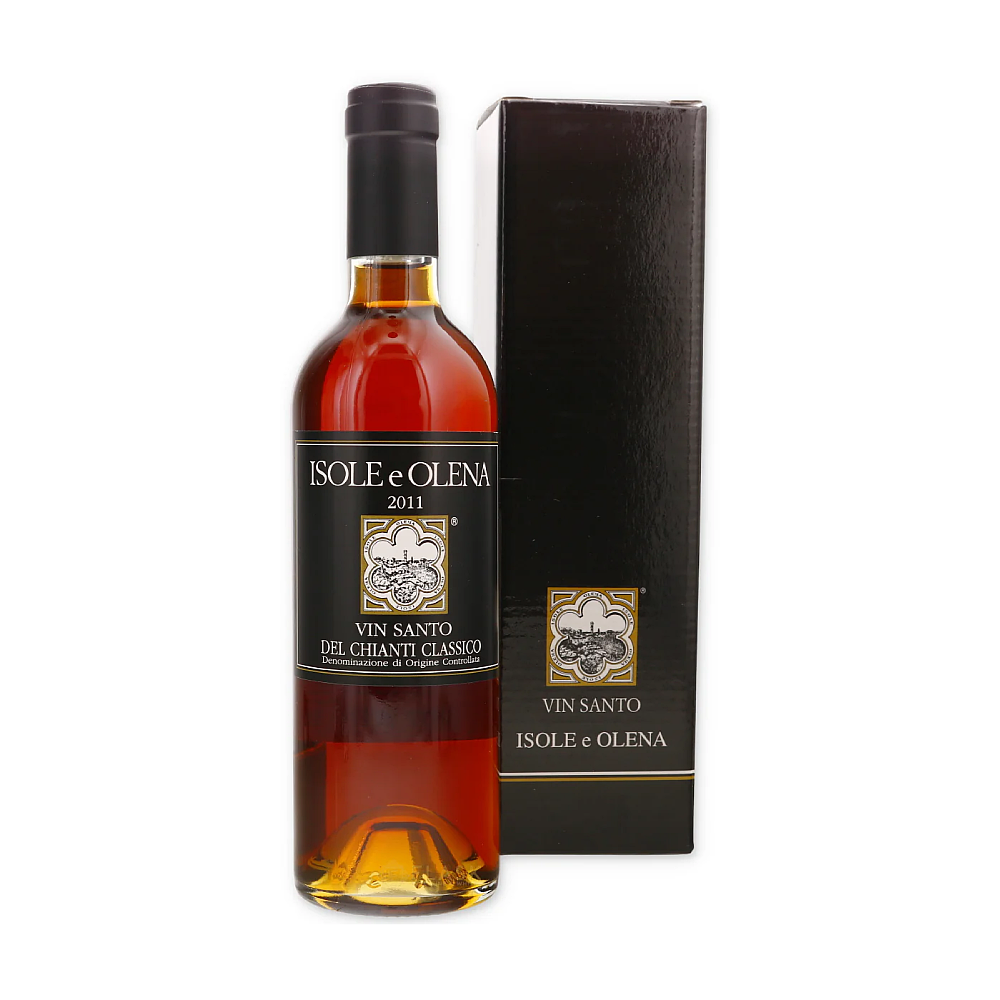
The Vin Santo, aged for eight years in small barrels called ‘caratelli’, is also among the finest currently produced. The grapes are grown on the Isole e Olena estate which covers 320 hectares, of which 49 are planted with vines and 55 with olives. The vineyards are approximately 400 metres above sea level and face south-west. The oldest vines on the estate were planted in 1958 and the youngest in 2007. When Paolo De Marchi arrived at Isole e Olena in 1976, he stopped using white grapes, Trebbiano and Malvasia, in the blend for Chianti. He then asked the old farmers how to make the best Vin Santo possible, using traditional methods, and used the white grapes for this wine.
The grapes were dried for three to five months before pressing, after which the must was racked into ‘caratelli’ (small barrels of varying composition) where it fermented and aged for eight years before bottling. The wine remained on the ‘madre’ or starter culture for the entire ageing/fermenting period, during which time it was neither racked nor filtered. At the end of the ageing period, the resulting yield in wine from grapes comprises only 12-15%; that is, for every 100 kilos of grapes, only about 12 to 15 litres of Vin Santo are produced!