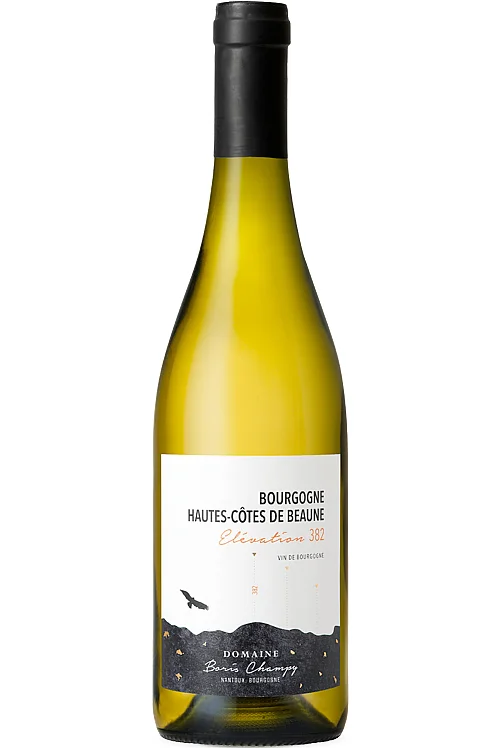
High in the hills above Pommard and Beaune, in the quiet village of Nantoux, lies one of the most quietly influential estates in Burgundy. It was founded in 1984 by Didier Montchovet with just half a hectare of rented vines. A pioneer of organic and biodynamic farming at a time when few in Burgundy took either seriously, Montchovet grew it into a 12-hectare domaine, widely regarded as the first in Burgundy to earn Demeter biodynamic certification. When he looked for a successor who would carry his philosophy forward, he found one in Boris Champy, who joined him for the 2019 harvest and took over the estate soon after.
Champy brought a remarkable pedigree. Born in Champagne and trained as an oenologist, he spent ten years at Dominus in the Napa Valley for Christian Moueix, of Pétrus fame. He then returned to Burgundy as technical director of Maison Louis Latour and later managed the celebrated Clos des Lambrays in Morey-Saint-Denis. He could have gone anywhere; he chose the Hautes-Côtes. Long overlooked for their cool, late-ripening climate, these higher slopes now ripen their grapes a week or so after the Côte below, preserving precious freshness and acidity as summers grow warmer. Champy is convinced they represent the future of Burgundy.
The estate remains certified organic and biodynamic, and Champy farms it as a living ecosystem rather than a monoculture. The vineyards are small islands of biodiversity, framed by hedges, dry-stone walls, orchards, limestone meadows and woodland, with sheep grazing between the rows. In the cellar the approach is equally respectful: hand harvesting, minimal intervention, and wines bottled unfined and unfiltered so that each parcel speaks with complete clarity.
The Presse Verticale 382 comes from the Montagne de Cras, a single plot at 382 metres in Nantoux. Its name comes from the Celtic word for pebbles, and its stony, clay-rich soils are planted densely with Chardonnay. Of the plot’s four hectares, one is left wild: scree, hedges, orchards and orchid-filled grassland, even a few rare service trees, whose hard wood was once used to make the screws of grape presses. Fittingly, the wine is defined by its press. Champy uses a traditional vertical press, the kind used in Burgundy from the Middle Ages until the 1960s, for a slow, gentle pressing that yields clear, concentrated juice. It is fermented in barrel and aged for around twelve months on its lees, half in new oak, before a few months in tank. The result is all precision: a deep, intense nose of orange zest, honey, white flowers, hazelnut and a hint of smoke, followed by a taut, dynamic palate with beautifully integrated oak and a long, mineral finish. Superb with sea bass and fennel, smoked salmon, roast poultry or aged Comté.